








Thailand Film Permit Cost & Work Permit: A Producer's Guide to Filming in Thailand
One of the first questions we usually get from an international producer planning a shoot in Thailand is a pretty simple one: how much does a Thailand film permit cost, and how long does it take to get one?
The answer to the first part is quite straightforward. The Thailand Film Office does not charge a government fee for the film permit itself. The costs that normally appear in a production budget come from preparing and submitting the application, local production coordination, using a registered Thai production company as the Local Coordinator, the Thailand Film Office monitoring officer assigned to the shoot, and any additional permissions or services required for the particular production. That distinction is important from the beginning. You can correctly say that the government fee for a Thailand film permit is zero, while still having a real permitting budget on your production.This is also why we built the Film Permit & Work Permit Calculator on the Film Service Thailand website. When you are putting together a preliminary budget, you usually do not need another long conversation with a local company just to get the first number into your spreadsheet. You need a sensible starting point based on the type of production, the number of foreign crew and the services you are likely to need.
Once the project becomes more specific, we can look at the actual locations, shooting schedule and crew and turn that first estimate into a proper production plan.
What Are You Actually Paying For When Filming in Thailand?
For a standard Thailand Film Office application, we prefer to keep the main costs separate rather than putting everything into one generic "film permit" line.Our current Film Service Thailand calculation is 20,000 THB for preparing and submitting the application, document preparation, translation and coordination. There is also a 20,000 THB fee for using our Thailand Film Office-registered production company as the Local Coordinator. The Thailand Film Office monitoring officer is calculated separately at 2,000 THB per shooting day.These are our current standard service costs. They are not government fees for the Thailand film permit itself. Depending on the production, there can be additional costs for specific filming locations, separate location permissions, foreign crew work authorization, visas, drones, protected areas and other production requirements.We prefer to show these items separately in the budget. It makes it much easier for an international producer to see what is fixed, what depends on the shooting plan and what could change if the locations or crew change.If you are specifically looking for the film permit cost in Thailand, our calculator is designed to give you a realistic starting figure rather than simply telling you that the government permit itself is free.
From our experience, one of the biggest misunderstandings about the Thailand filming permit process is the idea that the main challenge is waiting for government approval. Quite often, the real problem is that the production is not ready to submit a complete and consistent application when the producer thinks it is.That is completely normal on international productions. Projects are often being developed in several countries at the same time, and the Thailand schedule can still be moving while the creative team is making final decisions. A location may still be provisional because the director wants another option. A foreign HOD may be replaced a week before travel. A passport may be renewed after the crew list has already been prepared. None of this is unusual.The problem is that, at some point, all of those moving parts have to become specific enough to go into the official paperwork. The Thailand Film Office requires information about the production, shooting schedule, locations and foreign crew, together with supporting production material appropriate to the project. A foreign production also needs to work through a Local Coordinator registered with the Thailand Film Office. So when we prepare a Thailand film permit application for a client, we are not just checking whether the producer has "sent the documents". We are checking whether the information in those documents actually makes sense as a production. If the schedule says one thing, the crew list says something else and half the locations are still only options, you may technically have an application, but you are not really ready to submit it. That is where a good local production team earns its fee.
Who Submits a Thailand Film Permit Application?
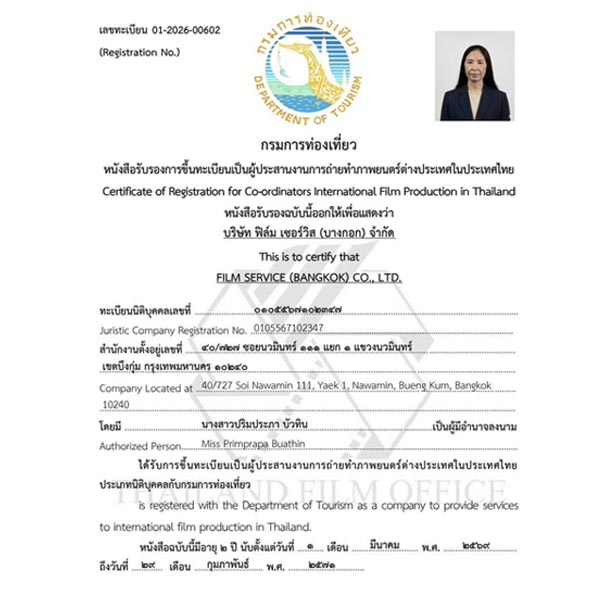
A foreign production does not simply file a Thailand film permit application directly from overseas. The production works through a Local Coordinator registered with the Thailand Film Office. The Local Coordinator prepares and submits the application and handles the local communication throughout the process. This is also how the official application form is structured — it is intended for the Local Coordinator.
That is one reason the choice of your Thai production partner matters more than it may seem when you are comparing quotes. You are not just paying someone to translate a form and drop some paperwork at an office. The Local Coordinator becomes the production's local point of contact throughout the permitting process. That becomes particularly important when the shoot involves several locations, multiple provinces or additional permissions from other government authorities.
Film Service Thailand handles the process directly through our own registered production company rather than passing the Thailand film permit application to another intermediary. Our registrations and relevant licences are available on the Film Service Thailand website, so an international producer can see exactly who is handling the production locally. For a straightforward commercial shoot, the process can be relatively simple. For a feature film, documentary series, reality production or a project moving through several parts of Thailand, your local coordinator needs to understand the production itself, not just the paperwork. That is how we approach it. The Thailand Film Office requires the main application documents together with production information and supporting material such as a synopsis, treatment, storyboard or script, depending on the type of project. You will also need a shooting schedule with specific dates and locations, as well as a foreign crew list including names, passport numbers, positions and arrival dates. From a producer's point of view, the important thing is not memorising the name of every document. What matters is that the Thailand film permit application describes the production you are actually planning to shoot. For a commercial, that might mean a treatment and storyboard. For a documentary, it could be a treatment and production description. A feature film obviously comes with a different level of script and production information.
We look at the project as a production rather than trying to force every type of shoot through exactly the same workflow. The foreign crew list deserves particular attention because it is one of the documents that tends to change during prep. Heads of department can be replaced, additional crew can be added and passport details can change.
There is no point pretending that every production decision is final when it is not. At the same time, there comes a point when the crew list needs to be locked so the application can move forward. Managing that balance is part of the job of the local production team.
How Long Does a Filming Permit in Thailand Take?
The Thailand Film Office has different review periods depending on the type of production. For advertising and public relations work, documentaries, music videos and television programmes, the stated review period is up to 3 business days. For short films, feature films, series, dramas, reality productions and television projects with sensitive content, the stated review period is 5–10 business days. These numbers are useful when you are building the production schedule, but they should not be treated as the total amount of time needed to clear a foreign production for filming in Thailand. The review period applies once the application is complete. It does not mean that every location is automatically cleared, and it does not include separate immigration, work authorization or special-location procedures that may need to run alongside the main Thailand film permit. For that reason, we normally work backwards from the first shooting day rather than simply adding ten business days to the date someone expects to submit the application. Once you add location permissions, foreign crew documentation and any special requirements, the overall preparation period can be considerably longer than the actual Film Office review. That is a much more useful way to plan a real production. A Thailand Film Permit Does Not Automatically Clear Every Location. This is probably one of the most important things for an international producer to understand if they have not worked in Thailand before. The Thailand film permit is the main approval for the foreign production, but certain locations are controlled by other government authorities or private owners and may require additional permission before you can shoot there. National parks, historical parks, museums, railway locations and other controlled areas can all have their own procedures, requirements and fees. The Thailand Film Office coordinates with the relevant authorities as part of the wider process, but getting the main film permit does not mean that a production can simply arrive at a national park or historical site and start shooting. This is where location planning becomes part of the filming permit Thailand process. If you are shooting on private locations in Bangkok, the permission chain may be relatively straightforward. If the same production moves through a national park, a historical site and a government-controlled location in different provinces, you may suddenly have several separate approval processes running at the same time.
We therefore prefer to look at the location list early rather than treating it as something that can be sorted out after the main Thailand film permit has been approved. Changing a location is not necessarily a disaster. But moving from one authority to another can create a completely different permission process, and that is something a producer should know before the change becomes part of the final shooting schedule.
Where You Shoot Directly Affects Your Film Permit Cost in Thailand
The fact that there is no government fee for the Thailand film permit should never be confused with the idea that filming everywhere in Thailand is free. Some locations have their own filming fees, deposits or permission procedures. National parks and historical sites are obvious examples, although the actual cost depends on the location, type of production and what you need to do there. That is why we keep the basic Thailand Film Office process separate from location-related costs in our budgets. It is much easier for a producer to understand a budget with separate lines for "Film Service coordination", "Thailand Film Office monitoring officer", "national park filming permission" and "location fee" than one unexplained line simply called "Thailand permits". It also makes budget changes much easier. If the director drops one national park from the schedule, we can remove or adjust that particular cost without rebuilding the entire Thailand film permit calculation. For international productions, that kind of transparency is much more useful than making the initial headline number look artificially low.
The Approved Production Material Still Matters Once the Cameras Roll is another part of the Thailand film permit process that can easily be forgotten during prep because everyone is focused on getting the permit approved. A Thailand Film Office monitoring officer is assigned to the production and monitors the filming against the approved production material. From a filmmaker's point of view, this is not particularly unusual. Every production changes once the cameras start rolling. The director finds a better angle, the weather changes the plan, the location looks different in reality, or a scene develops during rehearsal. The important thing is understanding when a normal creative adjustment is simply part of filming and when the production has moved far enough away from the approved material that the local coordinator should check the situation. We always recommend that the producer, director and 1st AD understand what was submitted as part of the Thailand film permit application. That does not mean the creative team cannot make decisions on the day. It simply means that the people making those decisions understand the regulatory framework around the production. It is much easier to deal with a question while the unit is still on location than to discover afterwards that a significant part of the day's filming did not correspond to the material that had been approved.
Thailand Work Permit, Visas and Foreign Crew Are a Separate Part of the Schedule
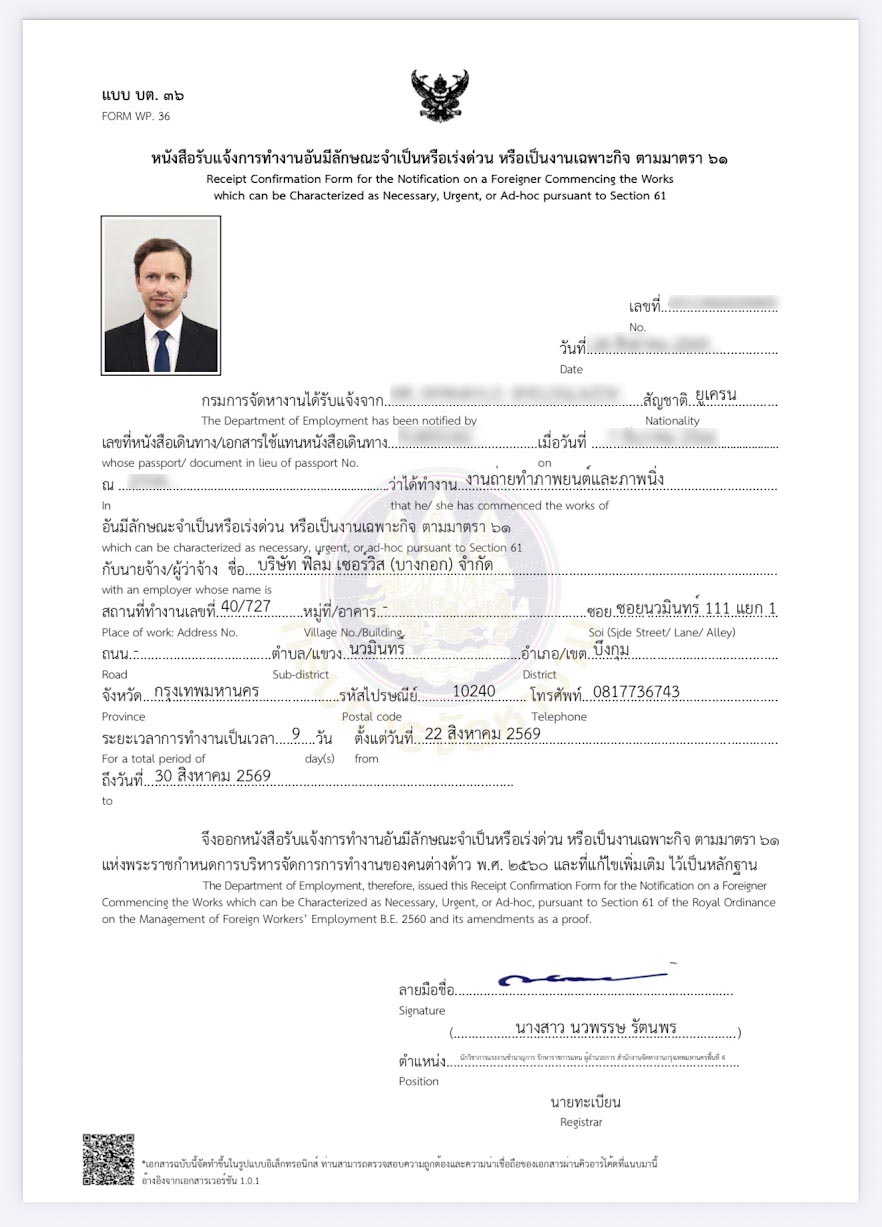
The Thailand film permit is not the same thing as the immigration and work requirements for foreign crew. If you are bringing a director, DP, gaffer, focus puller, DIT, production designer or another foreign specialist into Thailand to work on the production, their immigration status and Thailand work permit requirements need to be considered separately during prep. The Thailand Film Office also lists work permits and immigration among the related government processes connected with foreign film production in Thailand. This becomes particularly important when the foreign crew list is large or when people are arriving and leaving Thailand on different dates. We normally look at the crew list together with the film permit because both processes affect the same production schedule, even though they are handled through different procedures. For short-term foreign work, there is a separate notification procedure for work of up to 15 days, while work exceeding 15 days follows the work-permit application process. The exact route depends on the individual circumstances of the crew member and the production. That is why our calculator allows producers to look at Thailand film permit and work permit requirements together, rather than treating the film permit as the entire legal preparation for the shoot. A production with a small international crew and mostly local departments is obviously very different from a production bringing a large foreign camera, lighting, art or post-production team into Thailand.
The Same Applies to Equipment, Drones and Other Special Requirements
A camera package rented from us in Bangkok is one administrative situation. A full international camera and lighting package arriving under an ATA Carnet is something completely different. Drones are another consideration. Filming with animals, working in protected areas, shooting at night or working at certain controlled locations can introduce additional requirements depending on the circumstances. The Thailand Film Office provides separate information and forms for several of these categories, including national parks, historical sites, wildlife areas and drone filming. This is why we prefer to see the actual production brief rather than give a generic answer to the question, "How much is a filming permit in Thailand?" The permit is only one part of the overall production clearance. The production itself determines the rest. What We Recommend When the Schedule Is Still Moving? Do not wait until every single production decision is final before speaking to your Thailand coordinator.At the same time, do not submit a deliberately vague schedule just because someone wants to start the Thailand film permit process as early as possible. There is a practical middle ground, give us the information that is already confirmed. Tell us which locations are locked and which are still options. Give us the foreign crew you know you are bringing and flag anything unusual about the production — drones, protected locations, special vehicles, animals, night work, large equipment packages or filming across several provinces. From there, we can identify what needs to be locked for the filming permit application and what can continue to move during prep. That is how production actually works - a good local coordinator should be able to work with a moving production schedule rather than expecting an international producer to know every detail on day one.
Why We Built the Film Permit & Work Permit Calculator
We work with international producers at very different stages of development. Sometimes the production is already greenlit and we are preparing the complete Thailand package. Sometimes the producer is still comparing several countries and needs a realistic local number for a preliminary budget. Sometimes the client has sent a five-line brief and expects a Thailand estimate the following morning. At that stage, nobody needs a long meeting just to find out whether there is a government fee for a Thailand film permit.You need a number.
The Film Permit & Work Permit Calculator is there to give you that first number based on the production information you already have. It is not intended to replace a production-specific quotation, because the final film permit cost in Thailan can change once the actual locations, crew, shooting schedule and special requirements are confirmed. It is simply a faster way to understand the basic permitting budget before we start building the complete production plan. >Once the production becomes real, that is where we come in.
Film services in Thailand: Production First, Paperwork Second
We are not a government office and we are not a company that only fills out permit forms. >We work in production. So when we look at a Thailand film permit application, we are also thinking about the location recce, crew arrivals, shooting schedule, equipment, transport, local crew, weather, overtime and everything else that eventually has to work on the shooting day. For an international producer, that distinction matters. A permit that looks perfect on paper is not much use if the location permission is missing, the foreign crew paperwork is not ready or the shooting schedule simply does not work in real life. Our job is to put those pieces together early enough that they do not become a problem on the shooting day. So if you are currently building a Thailand production budget, start with the calculator and get the basic Thailand film permit cost into your estimate. If the production is more complicated — several provinces, protected locations, a large foreign crew, drones, special equipment or a very tight schedule — send us the brief and the schedule you have at the moment. We will look at it the same way we would look at any production we are preparing ourselves: What needs to be approved, what needs to be booked, what can still move, and what could stop the camera from rolling? That is the useful conversation to have before your crew flies to Thailand.